
Quick answer
What Is Arrhythmogenic Right Ventricular Cardiomyopathy?
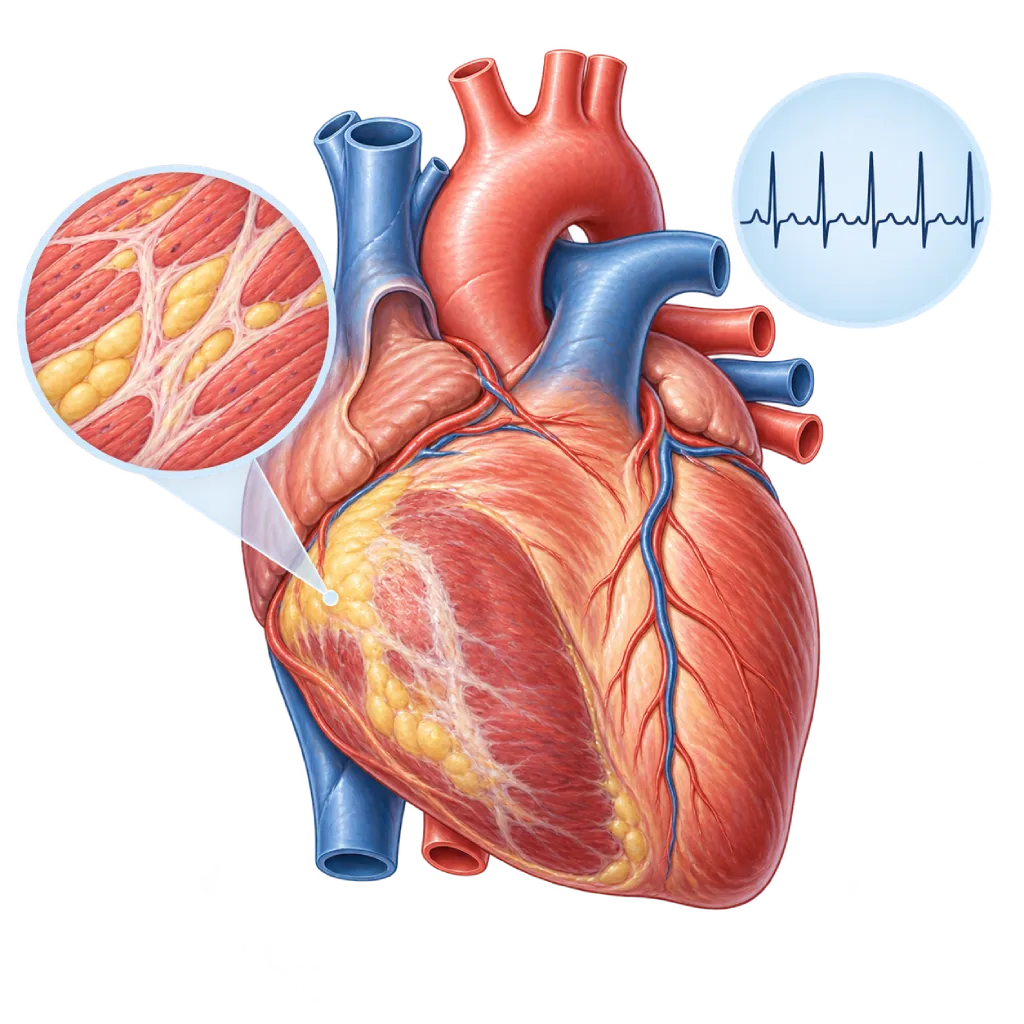
Arrhythmogenic right ventricular cardiomyopathy (ARVC) is a heart muscle disease that is usually inherited. The muscle of the right ventricle is gradually replaced by fat and scar tissue, so rhythm disorders from the ventricles develop easily and the heart's pumping can weaken.
SourcesSigns That Need Urgent Help
- Fainting during exercise or without a clear cause
- A very fast heartbeat with severe dizziness, pale skin, or cold sweat
- Chest pain or severe shortness of breath
- Suddenly collapsing, becoming unconscious, and not breathing normally
- The ICD delivers more than one shock within a short time
If these signs appear, go to the nearest emergency department right away or call Heart Attack Center 1500 258.
01 / Understanding the condition
About Arrhythmogenic Right Ventricular Cardiomyopathy
Arrhythmogenic right ventricular cardiomyopathy, or ARVC, is a heart muscle disease that in the majority of cases runs in families. In this disease, muscle cells in the wall of the right ventricle, the chamber that pumps blood to the lungs, gradually die and are replaced by fat and scar tissue. The wall of the right ventricle becomes thin and enlarged, and it no longer moves in a coordinated way. The scar tissue also disrupts the heart's electrical pathways, causing extra beats and fast rhythms from the ventricles.
The Cause Lies in the Genes
Many people with ARVC have changes in the genes that form desmosomes, the structures that bind one heart muscle cell to the cell next to it. Genes that are often involved include PKP2, DSP, DSG2, and DSC2. Weak bonds make the muscle cells easily damaged, especially when the heart works hard. The gene changes are usually inherited in an autosomal dominant pattern: each child of a gene carrier has about a 50 percent chance of inheriting it. However, not all gene carriers become ill, and the severity of the disease can differ between family members.
Who Is Affected and When
Symptoms usually begin between the late teens and the 40s, more often in men. Typical complaints are palpitations, dizziness, or fainting during or after exercise. In some people, cardiac arrest during activity is the first sign. ARVC is also one of the causes of sudden death in young athletes. In some people, the left ventricle is also affected, so some experts use a broader term: arrhythmogenic cardiomyopathy.
Strenuous Exercise Makes the Disease Worse
Research shows that frequent, strenuous endurance exercise brings on symptoms earlier and increases the risk of arrhythmia in gene carriers. For this reason, people with ARVC and gene carriers are advised to avoid strenuous and competitive sports. Light to moderate activity is usually still fine, as advised by your doctor.
Treatment
ARVC cannot yet be cured, but it can be controlled. Treatment aims to prevent sudden death, reduce rhythm disorders, and maintain pumping function. Options include limiting exercise, beta blockers and antiarrhythmic medicines, catheter ablation, and an implantable cardioverter defibrillator (ICD) for those at high risk. Close family members are advised to have a heart examination and genetic testing. The fast ventricular rhythms that can develop are covered on the Ventricular Tachycardia page.
02 / Understanding the condition
Symptoms to Recognize.
Common Symptoms
Many people have no symptoms in the early stage. Complaints often appear during or after exercise.
- Palpitations or a feeling of skipped beats
- A racing heartbeat during or after exercise
- Dizziness or light-headedness
- Fainting during or after physical activity
- Shortness of breath or tiring quickly during activity
- Chest pain or discomfort
- Leg swelling or an enlarged abdomen in the later stages
- No complaints, found during screening of family members
03 / Understanding the condition
What Causes This Condition?
- Changes in desmosome genes (which bind heart muscle cells together), for example PKP2, DSP, DSG2, or DSC2
- Changes in other genes outside the desmosome in a small number of people
- Gradual replacement of right ventricular muscle by fat and scar tissue
- A high workload on the heart from strenuous endurance exercise, which speeds up damage in gene carriers
- Rare recessive forms with stiff, woolly hair and thickened skin on the palms and soles (Naxos disease and Carvajal syndrome)
- In some people, the genetic cause cannot yet be found
04 / Understanding the condition
Who Is at Higher Risk?
Genetic
A family history of ARVC, sudden death at a young age, or desmosome gene carriers. Each child of a gene carrier has about a 50 percent chance of inheriting it.
Lifestyle
Strenuous, long, and frequent endurance exercise, such as long-distance running or competitive sports, brings on the disease and arrhythmias earlier in gene carriers.
Age
Symptoms usually begin between the late teens and the 40s and rarely appear before age 10.
Medical
A previous fainting episode due to arrhythmia, ventricular tachycardia, very frequent extra beats from the ventricles, or reduced right or left ventricular function signal a higher risk of serious events.
Other
Men have symptoms and serious arrhythmias more often than women with the same gene change.
Groups at Higher Risk
- Close Relatives of People with ARVC: Parents, siblings, and children of a person with ARVC may carry the same gene and need regular checkups.
- Athletes and Endurance Exercisers: Frequent strenuous exercise can bring on the disease earlier in gene carriers and trigger arrhythmias.
- Teenagers and Young Adults: Symptoms and serious arrhythmias often begin between the late teens and young adulthood.
- Male Gene Carriers: Men have symptoms and serious arrhythmias more often than women with the same gene.
05 / Understanding the condition
How Is It Diagnosed?
No single test is enough to confirm ARVC. Doctors use international diagnostic criteria that combine several findings: abnormalities in the size and movement of the right ventricle, the appearance of the muscle tissue, ECG patterns, the type of arrhythmia, and family history and genetic test results.
Testing usually starts with an ECG and Holter monitoring to look at the electrical pattern and count the extra beats from the ventricles. Echocardiography and cardiac MRI assess the size, wall movement, and scar tissue in both the right and left ventricles. A treadmill test can reveal arrhythmias that appear during activity. In certain situations, an electrophysiology study helps distinguish ARVC from a benign tachycardia arising from the right ventricular outflow tract. A heart muscle biopsy is now rarely needed. Once the diagnosis is made, your doctor assesses the risk of serious arrhythmias to decide whether an ICD is needed.
Electrocardiogram (ECG)
Looks for inverted T waves in the right chest leads, epsilon waves, and extra beats from the ventricles, which are among the diagnostic criteria for ARVC.
Holter Monitoring
Counts the extra beats from the ventricles over 24 hours or longer and captures short episodes of ventricular tachycardia.
Echocardiography
Assesses the size and wall movement of the right ventricle and the pumping strength of the left ventricle.
Cardiac MRI
Assesses the right ventricle in more detail, including enlargement, wall movement, and scar tissue, as well as involvement of the left ventricle.
Treadmill Stress Test
Shows whether arrhythmias appear when the heart's workload increases; done under a doctor's supervision.
Genetic testing in a person with ARVC helps confirm the diagnosis and allows targeted testing of family members.
Electrophysiology Study
Considered to distinguish ARVC from a benign tachycardia arising from the right ventricular outflow tract, or before ablation.
06 / Understanding the condition
Treatment Options.
Treatment is decided by a doctor after an assessment. The categories below can help you follow the conversation with your doctor.
Limiting Strenuous Exercise
Avoiding strenuous and competitive sports helps slow worsening and reduce arrhythmias. The types of activity that are safe are agreed with your doctor.
Beta Blockers and Antiarrhythmic Medicines
Beta blockers are generally recommended for people with ARVC. Other antiarrhythmic medicines are added if arrhythmias still occur. The type and dose are decided by your doctor.
Implantable Cardioverter Defibrillator (ICD)
Recommended for people who have had a cardiac arrest or sustained ventricular tachycardia, and considered for those at high risk based on a risk assessment.
Catheter Ablation
Disables the arrhythmia pathways from inside and sometimes from the outer surface of the heart, to reduce repeated episodes and ICD shocks. Ablation does not replace an ICD.
Heart Failure Treatment
Guideline-directed heart failure medicines are given when the pump weakens. In very advanced stages, a heart transplant may be considered.
Genetic Counseling and Family Screening
Helps families understand the inheritance pattern, genetic testing options, and the heart examination schedule for close relatives.
07 / Understanding the condition
Complications to Watch For.
Recurrent Ventricular Tachycardia
Fast rhythms from the ventricles can come back and cause palpitations, fainting, or repeated ICD shocks.
Cardiac Arrest and Sudden Death
A fast ventricular rhythm can turn into ventricular fibrillation, which stops the heart from pumping, sometimes as the first sign of the disease, especially during exercise.
Right or Biventricular Heart Failure
In the later stages, the right ventricle, and sometimes the left ventricle as well, weakens, causing shortness of breath, leg swelling, and an enlarged abdomen.
Blood Clots and Stroke
An enlarged ventricle or atrial fibrillation can form blood clots that travel to the lungs or brain. Your doctor assesses the need for anticoagulant medicine.
08 / Understanding the condition
What Can You Do?
- Avoid strenuous and competitive sports if you have ARVC or carry a gene that causes it
- Take your medicines on schedule and do not stop them without your doctor's guidance
- Have regular checkups, including an ECG, Holter monitoring, and heart imaging, even if you feel well
- Encourage close family members to have a heart examination and genetic counseling
- Encourage your family to learn chest compressions and how to use an AED
- Have your ICD checked on schedule and know what to do if the device delivers a shock
- Report fainting, new palpitations, or worsening shortness of breath right away
09 / Understanding the condition
When Should You See a Doctor?
ARVC often causes no symptoms at first, so complaints during exercise and a family history should be taken seriously. If someone faints and is not breathing normally, call emergency services at 119 right away and start chest compressions. Make an appointment with a cardiologist if:
- You have palpitations, dizziness, or near fainting during or after exercise
- You have fainted without a clear cause
- A family member has been diagnosed with ARVC or carries a gene that causes it
- A family member died suddenly before age 50
- Your ECG or Holter results show many extra beats from the ventricles
Don't Wait in an Emergency.
If symptoms are severe or come on suddenly, go to the nearest emergency department right away or call Heart Attack Center 1500 258, rather than waiting for an appointment.
10 / Common questions
Questions You May Have.
Frequently asked questions about arrhythmogenic right ventricular cardiomyopathy (ARVC).
How is ARVC different from other cardiomyopathies?
In hypertrophic cardiomyopathy, the heart muscle thickens; in dilated cardiomyopathy, the left ventricle enlarges and weakens. In ARVC, muscle mainly in the right ventricle is replaced by fat and scar tissue, and rhythm disorders often appear before the pump weakens. For this reason, the main complaints are usually palpitations or fainting rather than shortness of breath. Other types of cardiomyopathy are covered on the Cardiomyopathy page.
Can people with ARVC still exercise?
Yes, but the type of exercise needs to be chosen carefully. Strenuous and competitive sports, especially endurance sports such as long-distance running, should be avoided because they can speed up worsening and trigger arrhythmias. Light to moderate activity, such as walking or leisurely cycling, is generally still recommended for your health. Discuss your exercise plans with your doctor, including if you carry a causative gene without symptoms.
Does everyone with ARVC need an ICD?
Not everyone. An ICD is recommended for people who have had a cardiac arrest or sustained ventricular tachycardia. For others, your doctor assesses the risk based on any history of fainting, the number of extra beats, short runs of tachycardia on Holter monitoring, and the pumping strength of both ventricles, sometimes with the help of an ARVC-specific risk calculator. The decision is made together with you after the benefits and risks are explained.
If I carry an ARVC gene but have no symptoms, what should I do?
Not all gene carriers become ill, but the risk needs monitoring. Doctors generally recommend an ECG, Holter monitoring, and echocardiography or cardiac MRI at regular intervals, usually every one to three years. Gene carriers are also advised to avoid strenuous and competitive sports. Report palpitations, dizziness, or fainting right away, because these complaints can signal that the disease is becoming active.
Can ARVC be cured?
ARVC cannot yet be cured because it comes from a gene change. However, many people with ARVC can live active lives with good management: avoiding strenuous exercise, taking medicines as advised, having regular checkups, and using an ICD when needed. Ablation helps reduce repeated episodes. For a small number of people with advanced heart failure, a heart transplant may be an option.
Does my child need to be checked?
Yes. If you have ARVC or carry a gene that causes it, your children and siblings are advised to have an examination. If your gene change is already known, family members can have targeted genetic testing. Children who carry the gene usually start monitoring with an ECG and heart imaging from around age 10 to 12, which is then repeated regularly as advised by the doctor.
Sources and Medical Review
Translated from the Indonesian edition medically reviewed by Dr. dr. Dicky A. Hanafy, Sp.JP(K).
Sources as cited in the Indonesian edition.
- Arbelo E, Protonotarios A, Gimeno JR, et al. 2023 ESC Guidelines for the management of cardiomyopathies. Eur Heart J. 2023;44(37):3503-3626.
- Zeppenfeld K, Tfelt-Hansen J, de Riva M, et al. 2022 ESC Guidelines for the management of patients with ventricular arrhythmias and the prevention of sudden cardiac death. Eur Heart J. 2022;43(40):3997-4126.
- Towbin JA, McKenna WJ, Abrams DJ, et al. 2019 HRS expert consensus statement on evaluation, risk stratification, and management of arrhythmogenic cardiomyopathy. Heart Rhythm. 2019;16(11):e301-e372.
- Corrado D, Perazzolo Marra M, Zorzi A, et al. Diagnosis of arrhythmogenic cardiomyopathy: The Padua criteria. Int J Cardiol. 2020;319:106-114.
- Marcus FI, McKenna WJ, Sherrill D, et al. Diagnosis of arrhythmogenic right ventricular cardiomyopathy/dysplasia: proposed modification of the Task Force Criteria. Eur Heart J. 2010;31(7):806-814.
- James CA, Bhonsale A, Tichnell C, et al. Exercise increases age-related penetrance and arrhythmic risk in arrhythmogenic right ventricular dysplasia/cardiomyopathy-associated desmosomal mutation carriers. J Am Coll Cardiol. 2013;62(14):1290-1297.
Doctors Who Treat This Condition

Dr. dr. Dicky A. Hanafy, Sp.JP(K)
Arrhythmia and Electrophysiology
Arrhythmia and Device Center +1 center
Clinical focusElectrophysiology and Arrhythmia Ablation · Pacemaker and ICD Implantation
View Profile
dr. Sunu B. Raharjo, Sp.JP(K), Ph.D.
Arrhythmia and Electrophysiology
Arrhythmia and Device Center
Clinical focusClinical and Interventional Electrophysiology · Cardiac Arrhythmia Ablation
View Profile
Dr. med. dr. Denio A. Ridjab, Sp.JP(K)
Interventional Cardiology
Coronary Intervention Procedures +2 centers
Clinical focusInterventional Cardiology · Coronary Artery Disease
View Profile