
Quick answer
What Is Cardiac Resynchronization Therapy?
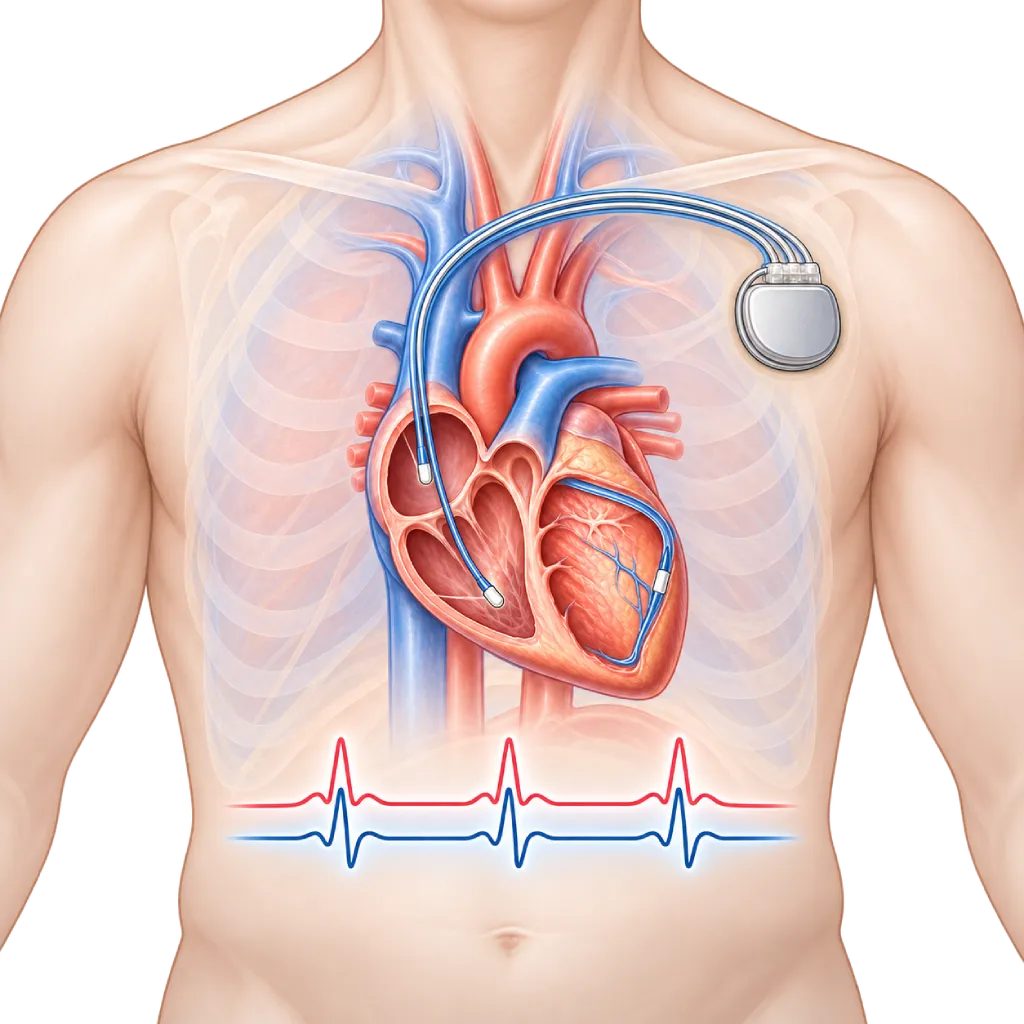
Cardiac resynchronization therapy, or CRT, is the implantation of a special pacemaker in heart failure with a weak pump and an electrical conduction disorder. Its leads pace the right and left ventricles almost simultaneously so they contract in sync again, which can improve symptoms and exercise capacity. Implantation under local anesthesia takes about 2 to 4 hours.
Sources01 / Understanding the procedure
About Cardiac Resynchronization Therapy
What Is Cardiac Resynchronization Therapy
In some people with heart failure, the electrical signal reaches the left ventricle late, for example because of left bundle branch block. As a result, the walls of the left ventricle do not contract in sync, and the already weak heart pump becomes even less efficient. Cardiac resynchronization therapy, or CRT, uses a special pacemaker to bring these contractions back into sync.
How It Works in Brief
A CRT device usually uses three leads (thin wires): in the right atrium, in the right ventricle, and in a vein on the surface of the left ventricle, reached through the coronary sinus, the opening of the heart's veins. The device paces both ventricles almost simultaneously on almost every heartbeat, so contractions are in sync again. In atrial fibrillation, the atrial lead may not be placed.
CRT-P and CRT-D
A CRT-P is a resynchronization device with a pacing function only, similar to a pacemaker. A CRT-D combines resynchronization with an ICD, so it can also stop dangerous ventricular rhythms with an electrical shock. These are covered on the Pacemaker Implantation and Implantable Cardioverter Defibrillator (ICD) pages. The doctor chooses the type based on the risk of sudden death, the cause of heart failure, your age, and your wishes.
Who Benefits
CRT is recommended for people with heart failure who still have symptoms despite taking guideline-based medicines, with an ejection fraction of 35 percent or less and a wide QRS wave on the ECG, a sign that the signal spreads slowly through the ventricles. The benefit is seen mainly with a QRS of 150 milliseconds or more with a left bundle branch block pattern; with a narrow QRS, CRT is not beneficial. CRT is also considered for people with a weak heart pump who need constant pacing because of heart block, and for pacemaker users whose pump has weakened. These tests are covered on the Electrocardiogram (ECG) and Echocardiography pages.
Results You Can Expect
In suitable patients, large studies show that CRT reduces symptoms, improves the ability to be active, reduces hospital stays for heart failure, and extends life expectancy. Some patients do not improve much even though the device works well. CRT complements, rather than replaces, heart failure medicines, which are covered on the Heart Failure Management page.
02 / Understanding the procedure
When Is This Procedure Considered?
A doctor may consider this procedure in the situations below. The decision is always made after a thorough assessment.
- Heart Failure with Left Bundle Branch BlockEjection fraction of 35 percent or less, QRS of 150 milliseconds or more, and ongoing symptoms.
- Wide QRS with Another PatternQRS of 130 to 149 milliseconds or a pattern other than left bundle branch block, after the doctor's assessment.
- Weak Pump That Needs Constant PacingHigh-grade heart block with a low ejection fraction; CRT is chosen over right ventricular pacing alone.
- Weakened Pump After Pacemaker UseFrequent right ventricular pacing can weaken the pump; the device can be upgraded to CRT.
- Atrial Fibrillation with Heart FailureIn selected patients, for example when the AV node is deactivated to control the heart rate.
Situations to Consider First
- Narrow QRSQRS of less than 130 milliseconds; CRT is not beneficial and may be harmful.
- Heart Failure Medicines Not Yet Adequately TriedGuideline-based medicines are given first, because some weak heart pumps improve with medicines.
- Very Limited Life ExpectancyFor example, less than 1 year due to another serious illness, so the benefit is small.
- Active InfectionImplantation is postponed until the infection is treated to prevent device infection.
03 / Before the procedure
How Should You Prepare?
Before implantation, the doctor makes sure you have been taking guideline-based heart failure medicines for several months, then reassesses your ECG and echocardiography.
Fasting. Usually no food or drink for about 6 hours before the procedure.
Medicines. Blood thinners, diabetes medicines, and water pills (diuretics) may be adjusted on the day of the procedure. Follow the team's instructions and do not stop any medicine on your own.
Kidney function. Blood tests are done because placing the left ventricular lead uses contrast dye.
Preventing infection. The skin of your chest is cleaned and antibiotics are given through an IV line about 1 hour before the procedure. Tell the team if you have a fever or are unwell.
Information for the team. Tell the team about any allergies, especially to contrast, and whether you can lie flat on your back for a long time without becoming short of breath.
Unsure about the preparation instructions? Ask our team before the procedure.
04 / During the procedure
How Is the Procedure Done?
Implantation is done in the catheterization lab and takes about 2 to 4 hours, longer than a standard pacemaker because of the left ventricular lead. The skin below the collarbone is numbed with local anesthesia and you are given a sedative.
Creating the Device Pocket
The doctor makes a small incision below the collarbone and forms a pocket under the skin or the chest muscle.
Placing the Right Heart Leads
A lead is advanced through a vein to the right ventricle under X-ray guidance and, if your rhythm is not atrial fibrillation, also to the right atrium.
Placing the Left Ventricular Lead
The doctor inserts a tube into the coronary sinus and injects contrast to see the heart's veins. A thin lead is then placed in a suitable vein on the surface of the left ventricle and tested to make sure it does not stimulate the diaphragm nerve. If this is not successful, the doctor may pace the heart's conduction pathway directly or, rarely, place the lead through a minor operation.
Connecting and Programming the Device
The leads are connected to the generator, the device is placed in the pocket, and the wound is stitched. The device is programmed so both ventricles are paced on almost every heartbeat.
05 / Benefits and risks
Benefits and Risks Should Be Discussed Together.
Every medical procedure has benefits and risks. Your doctor will explain both for your situation before the procedure.
Benefits You Can Expect
- Less Shortness of Breath and FatigueMany patients can walk farther and be active more comfortably.
- Fewer Hospital Stays for Heart FailureLarge studies show that hospital stays for heart failure are reduced.
- Longer Life ExpectancyIn suitable patients, CRT reduces deaths compared with medicines alone.
- The Heart Pump Can ImproveIn many patients, the left ventricle becomes smaller and the ejection fraction increases.
- Protection from Sudden Death with CRT-DThe built-in ICD function can stop dangerous ventricular rhythms.
The benefits of a procedure are not a promise of a cure. Ask how the results will affect your care plan.
Risks You Should Know
- Left Ventricular Lead DisplacementMore common than with other leads and may require a repeat procedure.
- Diaphragm Twitching or HiccupsCaused by the left ventricular lead stimulating a nerve; usually resolved by changing the settings.
- Left Ventricular Lead Cannot Be PlacedIf the heart's veins are not suitable; another approach is used, such as conduction system pacing.
- Device InfectionRare; if it occurs, the entire device and leads usually need to be removed.
- Bruising or Blood-Filled SwellingMore likely in people taking blood thinners; usually improves with pressure.
- Kidney Problems from ContrastRare; kidney function is checked before and after the procedure.
Risks can differ from person to person. A full explanation and consent are given after an individual assessment.
06 / After the procedure
What Is Recovery Like?
Patients usually stay 1 to 2 nights. Before you go home, the device is checked, a chest X-ray is taken, and you receive a device identification card.
Wound and arm. Keep the wound dry for about 1 week. Avoid raising the arm on the device side above your shoulder and avoid heavy lifting for about 4 to 6 weeks.
Heart failure medicines. Keep taking them. The doses may be adjusted once your condition improves.
Assessing the results. Symptoms often improve within a few weeks to months. Echocardiography is usually repeated about 3 to 6 months after implantation, and the device settings may be adjusted.
Device checks. Regular checks at the clinic and from home, which are covered on the Remote Heart Monitoring page. The device needs to pace almost every heartbeat to be beneficial, so arrhythmias that interfere with pacing are also treated.
Warning signs to watch for. Go to the emergency room right away if you experience:
- Worsening shortness of breath, especially when lying down
- Leg swelling or rapid weight gain over a few days
- Severe dizziness or fainting
- Repeated shocks from a CRT-D, or a shock with chest pain
- A wound that is red, swollen, or oozing pus, or accompanied by fever
- Persistent hiccups or twitching of the abdominal muscles
Know the Signs That Need Prompt Care.
Follow the team's guidance on warning signs. If severe or sudden symptoms appear after the procedure, go to the nearest emergency department right away or call Heart Attack Center 1500 258.
07 / Team and support
Doctors and Procedure Support
The doctors below are listed for this procedure. Listed by name, not by ranking.

Dr. dr. Dicky A. Hanafy, Sp.JP(K)
Arrhythmia and Electrophysiology
Arrhythmia and Device Center +1 center
Clinical focusElectrophysiology and Arrhythmia Ablation · Pacemaker and ICD Implantation
View Profile
Dr. dr. Faris Basalamah, Sp.JP(K)
Interventional Cardiology
Coronary Intervention Procedures +1 center
Clinical focusComplex Coronary Intervention · Cardiac Electrophysiology
View Profile
dr. Sunu B. Raharjo, Sp.JP(K), Ph.D.
Arrhythmia and Electrophysiology
Arrhythmia and Device Center
Clinical focusClinical and Interventional Electrophysiology · Cardiac Arrhythmia Ablation
View ProfileElectrophysiology (EP) Laboratory
A dedicated procedure room for electrophysiology studies, catheter ablation, and implantation of heart rhythm devices such as…
The availability of technology and test support is confirmed with the team. Technology is chosen according to clinical need.
08 / Common questions
Before You Plan the Procedure.
Frequently asked questions about cardiac resynchronization therapy.
What is the difference between CRT and a standard pacemaker?
A standard pacemaker usually paces the right ventricle to treat a heartbeat that is too slow. CRT paces the right and left ventricles almost simultaneously to synchronize contractions in a weak heart pump, even if your heartbeat is not slow. For this reason, CRT needs an additional lead on the surface of the left ventricle. Standard pacemakers are covered on the Pacemaker Implantation page.
Do I need a CRT-P or a CRT-D?
A CRT-D is considered if the risk of sudden death is high, for example with a weak heart pump caused by a past heart attack or after an episode of ventricular tachycardia. A CRT-P may be chosen in older age, with another serious illness, or according to the patient's wishes after discussion. The doctor weighs the benefit of the shock function against device size, battery life, and the chance of unnecessary shocks.
When will I feel the benefits?
Some patients find breathing easier within a few weeks, while improvement in the heart pump is usually assessed after 3 to 6 months with echocardiography. Some patients do not improve much even though the device works well. In that case, the doctor checks the device settings, the lead position, any arrhythmias that interfere with pacing, and your heart failure medicines.
Can I stop taking heart failure medicines after CRT?
No. CRT complements heart failure medicines rather than replacing them. The medicines are still needed to protect the heart, and the doses can often even be increased because the device keeps the heartbeat from becoming too slow. Do not stop or reduce your medicines without consulting your doctor. Heart failure treatment is covered on the Heart Failure Management page.
Is CRT implantation painful, and how long is the hospital stay?
The skin is numbed with local anesthesia and you are given a sedative, so you usually feel only the initial needle prick and some pressure. The procedure takes about 2 to 4 hours because the left ventricular lead needs to be positioned carefully. The majority of patients stay 1 to 2 nights. The wound feels mildly sore for a few days and can be managed with pain relievers.
How long does a CRT battery last?
Usually about 5 to 10 years, depending on the type of device and its settings. A CRT-D usually runs down faster than a CRT-P because it needs power for the shock function, and CRT paces almost every heartbeat. The remaining battery life is monitored at every follow-up visit, and generator replacement is planned before the battery runs out, through a minor procedure under local anesthesia.
Sources and Medical Review
Translated from the Indonesian edition medically reviewed by Dr. dr. Dicky A. Hanafy, Sp.JP(K).
Sources as cited in the Indonesian edition.
- Glikson M, Nielsen JC, Kronborg MB, et al. 2021 ESC Guidelines on cardiac pacing and cardiac resynchronization therapy. Eur Heart J. 2021;42(35):3427-3520.
- McDonagh TA, Metra M, Adamo M, et al. 2021 ESC Guidelines for the diagnosis and treatment of acute and chronic heart failure. Eur Heart J. 2021;42(36):3599-3726.
- Chung MK, Patton KK, Lau CP, et al. 2023 HRS/APHRS/LAHRS guideline on cardiac physiologic pacing for the avoidance and mitigation of heart failure. Heart Rhythm. 2023;20(9):e17-e91.
- Cleland JGF, Daubert JC, Erdmann E, et al. The Effect of Cardiac Resynchronization on Morbidity and Mortality in Heart Failure. N Engl J Med. 2005;352(15):1539-1549.
- Bristow MR, Saxon LA, Boehmer J, et al. Cardiac-Resynchronization Therapy with or without an Implantable Defibrillator in Advanced Chronic Heart Failure. N Engl J Med. 2004;350(21):2140-2150.
- Tang ASL, Wells GA, Talajic M, et al. Cardiac-Resynchronization Therapy for Mild-to-Moderate Heart Failure. N Engl J Med. 2010;363(25):2385-2395.
- Ruschitzka F, Abraham WT, Singh JP, et al. Cardiac-Resynchronization Therapy in Heart Failure with a Narrow QRS Complex. N Engl J Med. 2013;369(15):1395-1405.