Quick answer
A leaky heart valve (regurgitation) can range from mild to severe. Mild leaks often cause no symptoms and only need regular monitoring, while severe leaks can lead to heart failure or heart rhythm disorders if left untreated. Medications help control symptoms but do not repair the valve. If the leak is severe, the doctor may consider repairing or replacing the valve through surgery or a catheter-based procedure.
If you often feel tired for no clear reason or short of breath during activity, these complaints may be one sign of a leaky heart valve that should be confirmed through a doctor’s examination. Learn when this condition calls for attention and how it is treated.
Hearing the term leaky heart valve often triggers immediate worry, especially if you are looking after your health at an age that is no longer young. However, it is important to know that this condition does not always mean something dangerous. With the right understanding, you can recognize this condition earlier and take the right steps.
Simply put, a leaky heart valve is a condition in which a heart valve does not close completely, so some blood flows back in the direction it came from. In medical terms, this condition is known as heart valve regurgitation. Normally, heart valves work like “one-way doors” that keep blood flowing smoothly. When a leak occurs, the heart may work less efficiently because it has to pump harder.
In fact, this condition is fairly common, especially in older adults. Changes in valve structure due to aging, as well as conditions such as hypertension or previous heart disease, can increase the risk of valve leakage. According to the American Heart Association, heart valve problems often develop slowly and may cause no symptoms in the early stages.
However, not every leaky heart valve is dangerous or requires surgery. Many mild cases only need routine monitoring and management of risk factors. With today’s advances in medical technology, diagnosis and treatment have also become much more accurate and effective, so patients’ quality of life can still be maintained.
That is why understanding a leaky heart valve early on is an important step. In this article, you will learn about:
- Symptoms to watch for
- Causes and risk factors
- How doctors diagnose this condition
- And the treatment options available
Next, let’s start by first understanding what a leaky heart valve is and how this condition affects the way your heart works.
What Is a Leaky Heart Valve?
A leaky heart valve is a condition in which one of the valves inside the heart does not close completely, so some blood flows back in a direction it should not. Simply put, blood flow that ideally moves in one direction “reverses”.
To make it easier to understand, imagine a heart valve as a one-way door. Under normal conditions, this door opens to only one side so blood flows forward smoothly. However, when the valve does not close tightly, a small gap allows blood to flow back, even if only partly.
In medical terms, this condition is known as heart valve regurgitation. Valve problems like this can develop slowly and often do not cause symptoms right away in the early stages.
However, it is important to understand that a leaky heart valve does not always mean a dangerous condition. Its severity varies widely, from mild with no symptoms to conditions that require further medical treatment. That is why understanding this condition early is an important step in maintaining your overall heart health.
What Happens to the Heart When a Valve Leaks?
To understand the impact, let’s look at the difference in simple terms.
When the heart valve works normally:
- The valve opens to let blood flow forward
- The valve closes tightly to prevent backflow
- Blood flow is efficient and directed
When a heart valve leaks:
- The valve does not close completely
- Some blood flows back (backflow)
- The heart has to work harder to maintain blood flow throughout the body
This backflow can gradually increase the heart’s workload and, over the long term, may affect heart function if not properly monitored.
However, the body has a fairly good ability to adapt, especially in the early stages. In fact, many people do not realize they have a leaky heart valve because the symptoms can be very mild or not felt at all.
Next, let’s take a closer look at how the heart and its valves work normally, so you can understand the important role each valve plays in keeping blood flowing optimally.
Getting to Know the Heart and Its Valves
To understand a condition like a leaky heart valve, the first step is to learn how the heart works, especially the important role of the valves inside it. Simply put, the heart is not only a pump but also a system that regulates blood flow so it stays directed and efficient.
Inside the heart there are four main valves that work like “one-way doors”. These valves open and close automatically with every heartbeat, making sure blood flows in the right direction. When one of the valves does not work optimally, as with a leaky heart valve, blood flow can be disrupted.
The Four Heart Valves and Their Functions
Here are the four heart valves and their main functions:
1. Tricuspid Valve
- Located between the right atrium and the right ventricle
- Lets blood flow from the atrium into the right ventricle
- Prevents blood from flowing back into the atrium
2. Pulmonary Valve
- Located between the right ventricle and the pulmonary artery
- Directs blood from the heart to the lungs to pick up oxygen
3. Mitral Valve
- Located between the left atrium and the left ventricle
- Lets oxygen-rich blood flow into the left ventricle
- The valve most often affected by problems
4. Aortic Valve
- Located between the left ventricle and the aorta
- Sends blood from the heart to the rest of the body
These four valves work in coordination to keep blood flowing in one direction and efficiently.
Why Are Heart Valves So Important?
The role of heart valves may seem simple, but their impact on overall heart health is very large.
Heart valves function to:
- Keep blood flowing in one direction without obstruction
- Prevent backflow that can burden the heart
- Help the heart work more efficiently and in coordination
In addition, the valves also ensure that each chamber of the heart works according to its function. If this system is disrupted, blood distribution to the lungs and the rest of the body is also affected.
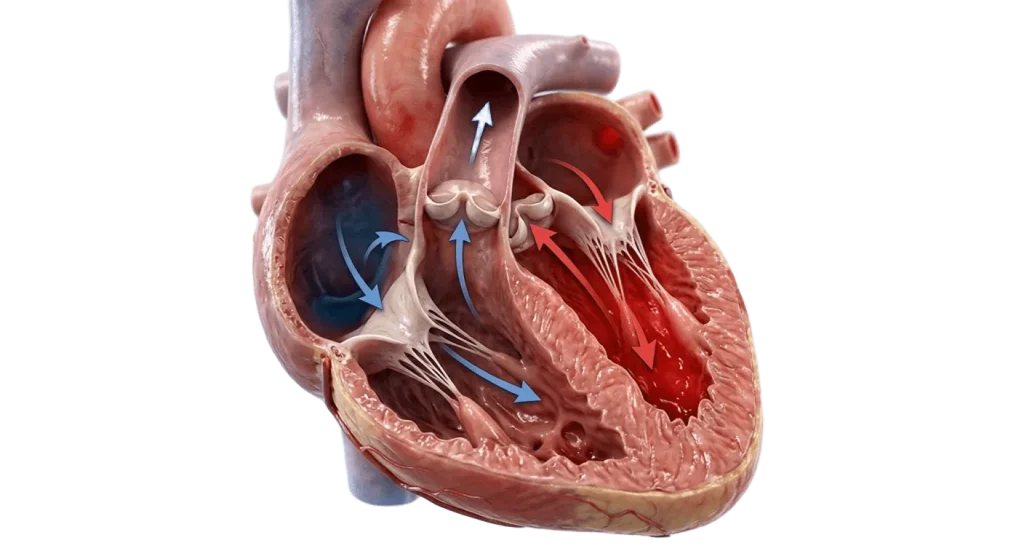
However, when a heart valve leaks, the valve cannot close completely. As a result, some blood flows back, so the heart needs to work harder to maintain optimal blood flow. Over the long term, this condition can affect the size and function of the heart if not properly monitored.
Heart valve problems can affect the pressure and volume of blood inside the heart, which in turn affects the heart’s overall performance.
Why Can a Heart Valve Leak?
Understanding the causes of a leaky heart valve helps you see a more complete picture: it is not simply a condition that appears suddenly, but often the result of a process that unfolds slowly. Indeed, many people only become aware of it when symptoms appear. In fact, however, changes in the heart valve may have occurred long before.
Heart valve leakage generally occurs when the valve structure weakens, changes shape, or is pushed by excess pressure inside the heart. That is why understanding the causes and risk factors is an important step for prevention and early detection.
Common Causes of a Leaky Heart Valve
Under normal conditions, heart valves work like one-way doors, opening to let blood flow through and then closing tightly so it does not flow back. However, when a valve does not close completely, blood can flow backward. This is what is called a leaky heart valve.
Here are some of the most common causes:
1. Aging (Degenerative)
As we age, valve tissue undergoes natural changes.
- The valve becomes stiffer or thicker
- Elasticity decreases
- Closure is no longer complete
In fact, this condition is often found in people over 50 years of age and is the main cause in older age groups.
2. Hypertension (High Blood Pressure)
High blood pressure makes the heart work harder than usual.
- The heart chambers can enlarge
- The valve structure gets pulled along
- The valve does not close tightly
That is why uncontrolled hypertension can speed up the development of a leaky heart valve.
3. Previous Heart Disease
A history of heart problems can affect valve function.
Examples:
These conditions can change the shape and position of the valve, so blood flow becomes abnormal.
4. Heart Infection (Endocarditis)
A bacterial infection of the inner lining of the heart can damage the valve directly.
- The valve becomes injured or changes shape
- Closure becomes less than optimal
- In some cases, the damage occurs fairly quickly
5. History of Rheumatic Fever
Rheumatic fever is a complication of a bacterial infection that was not properly treated.
- Causes permanent damage to the valve
- The effects can appear years later
Risk Factors to Watch For
Besides direct causes, several factors increase a person’s risk of developing a leaky heart valve. Interestingly, many of them are conditions you may already have right now.
1. Diabetes
- Can accelerate damage to blood vessels and heart tissue
- Increases the overall risk of heart disease
2. Family History
- Some valve disorders are genetic
- The risk increases if a family member has heart disease
3. Daily Lifestyle
Habits that seem simple can turn out to have a big impact:
- A diet high in fat and salt
- Lack of physical activity
- Smoking
- Prolonged stress
Not only do they affect heart health in general, they can also worsen the condition of the valves.
Why Is It Important to Understand the Causes?
Frankly, understanding the causes of a leaky heart valve is not meant to frighten you, but to give you a sense of control. With that knowledge, you can:
- Be more alert to existing conditions (such as hypertension or diabetes)
- Take preventive steps earlier
- Know when you need to get checked
However, knowing the causes alone is not enough. Symptoms of a leaky heart valve often appear subtly and are easy to miss.
In the next section, we will discuss the symptoms of a leaky heart valve to watch for, so you can recognize the signs earlier.
To understand its link with other conditions, you can also read:
Symptoms of a Leaky Heart Valve to Watch For
Symptoms of a leaky heart valve often do not appear suddenly. Instead, complaints develop slowly and are frequently mistaken for ordinary fatigue or aging. Indeed, in the early stages, some people do not feel any symptoms at all. Over time, however, the body begins to send signals that deserve attention.
Symptoms of heart valve leakage are closely related to how much blood flows back (leaks) and how the heart adapts to the condition. That is why recognizing symptoms early is key to preventing the condition from getting worse.
Common Symptoms of a Leaky Heart Valve
Here are some of the most common symptoms of a leaky heart valve to watch for:
1. Shortness of Breath
Shortness of breath is often the first sign people notice.
- Occurs during light to moderate activity
- Can appear when lying down or sleeping
- Caused by fluid buildup in the lungs due to inefficient blood flow
In fact, some people feel more comfortable sleeping with their head raised.
2. Tiring Easily
The body feels tired quickly for no clear reason.
- Light activities feel harder than usual
- Energy declines gradually
- Occurs because the oxygen supply to body tissues is not optimal
That is why a gradual change in stamina is often a sign that goes unnoticed.
3. Pounding Heart (Palpitations)
The heartbeat feels different from usual.
- Beating fast, irregularly, or feeling like it “skips”
- Appears as the heart’s response to maintain blood flow
4. Dizziness or Lightheadedness
Unstable blood flow to the brain can trigger this symptom.
- A floating feeling or nearly fainting
- More noticeable when standing or being active
5. Swelling in the Legs or Ankles (Edema)
Fluid buildup in the lower body.
- Legs or ankles look swollen
- Feel heavy or uncomfortable
- Usually worse in the afternoon
Symptoms That Are Often Overlooked
Beyond the obvious symptoms, a leaky heart valve is also often marked by mild complaints that tend to be ignored. Yet these symptoms can be early signals.
1. Getting Tired Quickly
- Tiring easily during daily activities
- Often dismissed as “just getting older”
In fact, this can be an early sign of a blood flow problem.
2. Shortness of Breath During Light Activity
- Getting winded when walking casually or climbing stairs
- Out of proportion to the level of activity
That is why it is important to pay attention to small changes in your breathing.
3. Reduced Stamina
- Activities that used to feel light now feel harder
- Recovery takes longer
When Should Symptoms Be Taken Seriously?
Frankly, the main challenge with symptoms of a leaky heart valve is that they are often vague. However, you need to be more alert if:
- Symptoms recur or become more frequent
- Daily activities start to be disrupted
- Complaints do not improve even after rest
That is why you should not wait for symptoms to become severe. Getting checked earlier can help find problems before they develop further.
Why Is It Important Not to Ignore Symptoms?
Although they may seem mild, symptoms of a leaky heart valve reflect changes in the way the heart works. So, the sooner they are recognized:
- Treatment can be more precise
- The risk of complications can be reduced
- Quality of life can be maintained
In addition, understanding the symptoms also helps you communicate more clearly with your doctor during a consultation.
In the next section, we will discuss how doctors diagnose a leaky heart valve, including the types of tests commonly performed and what you can expect during the process.
How Do Doctors Diagnose a Leaky Heart Valve?
Whether someone has a leaky heart valve cannot be determined from symptoms or personal guesses alone. Indeed, complaints such as shortness of breath or getting tired quickly are often early signs. However, these symptoms are not specific and can resemble other conditions. That is why doctors use a step-by-step, structured approach to confirm the diagnosis accurately.
Diagnosing heart valve disease should combine clinical evaluation and supporting tests, not rely on a single method.
Initial Examination: Understanding Your Symptoms and History
First, the doctor will start with a basic evaluation that often plays a major role in determining the direction of the diagnosis.
1. Medical interview (history taking)
The doctor will ask about several important things, such as:
- Main symptoms: shortness of breath, palpitations, tiring easily
- When the symptoms appeared and how they have progressed
- Medical history: hypertension, diabetes, infections, or rheumatic fever
- Family history of heart disease
In addition, the doctor will also assess whether the symptoms interfere with daily activities. This information helps screen for a possible leaky heart valve early on.
2. Physical examination
Next, the doctor will perform a direct examination, including:
- Listening to heart sounds with a stethoscope → An extra sound (murmur) can indicate abnormal blood flow
- Checking blood pressure and pulse
- Looking for other signs such as leg swelling or labored breathing
Although it may seem simple, this stage often provides strong clinical clues.
Main Test: Echocardiography (Heart Ultrasound)
If a leaky heart valve is suspected, the next step is the main test: echocardiography.
What is echocardiography?
Echocardiography is a test that uses sound waves (ultrasound) to see the structure and function of the heart directly.
Why is this important?
- Shows the shape and movement of the heart valves in real time
- Shows whether the valves close completely or not
- Identifies blood flow, including any backflow
- Assesses the severity of the leak
In other words, if a stethoscope helps the doctor “hear”, echocardiography helps the doctor “see” the actual condition.
Echocardiography is the main method for evaluating heart valve disorders noninvasively.
Additional Tests: For a More Complete Picture
In some cases, the doctor may recommend additional tests to clarify the condition.
1. Electrocardiogram (ECG)
- Records the electrical activity of the heart
- Helps detect rhythm disturbances that may accompany a leaky heart valve
2. Advanced imaging tests
If needed:
- Chest X-ray → assesses heart size and lung condition
- Cardiac CT scan or MRI → provides more in-depth structural detail
However, not every patient needs these tests. The doctor will tailor them to each person’s condition.
Treatment for a Leaky Heart Valve
Treatment for a leaky heart valve depends greatly on the severity and each patient’s overall health. The good news is that not every case requires surgery. The doctor will determine the appropriate approach step by step, from monitoring to medical procedures, with the goal of keeping heart function optimal and preventing complications.
Routine Monitoring for Mild Cases
In the early stages or when the leak is still mild, the doctor usually does not take aggressive action right away.
First, the patient will undergo regular monitoring, which includes:
- Routine symptom evaluation
- Heart tests (such as echocardiography) at certain intervals
- Monitoring of blood pressure and accompanying conditions
This approach is important because a leaky heart valve can develop slowly without clear symptoms at first. With proper monitoring, the doctor can detect changes early and determine the right time for intervention.
Medications to Control Symptoms
If symptoms start to appear or other conditions are present, the doctor may prescribe medications to help ease the heart’s workload.
Next, commonly used medications include:
- Medications to control blood pressure
- Medications to reduce fluid buildup (diuretics)
- Medications to help the heart work more efficiently
However, it is important to understand that medications do not directly repair a leaky valve. Their role is to control symptoms and slow the progression of the condition.
Medical Procedures: From Nonsurgical Options to Surgery
If the leak becomes more severe or starts to interfere with heart function, the doctor will consider further medical procedures.
Then, treatment options may include:
1. Nonsurgical Procedures (Minimally Invasive)
- Performed without major surgery
- Uses a catheter (a thin tube) inserted through a blood vessel
- Suitable for patients at high surgical risk
2. Valve Repair or Replacement Surgery
- Performed when valve damage is already significant
- Can involve repairing the native valve or replacing it with an artificial valve
- Recommended based on a thorough evaluation by a cardiologist
The decision on these procedures takes many factors into account, from the degree of leakage and symptoms to the overall condition of the heart.
Not Every Case Requires Surgery
As an important point, not every case of a leaky heart valve requires surgery. Many patients can live a normal life with just proper monitoring and treatment.
However, the main key is early detection and accurate medical evaluation. Without proper examination, this condition can develop unnoticed and carries the risk of complications later on.
Is a Leaky Heart Valve Dangerous?
Whether a leaky heart valve is dangerous depends on its severity. In some people, the condition is very mild and causes no significant problems. In other cases, however, a more severe leak can significantly affect how the heart works.
Indeed, it is important to understand that a leaky heart valve is not a “one-size-fits-all” condition. Its spectrum is broad, from mild to serious, and each stage has different implications for heart health.
Severity Determines the Impact
First, let’s understand how severity affects risk:
- Mild
- Usually causes no symptoms
- Often found incidentally during a heart examination
- Regular monitoring is usually enough
- Moderate
- Complaints such as tiring easily or shortness of breath during activity begin to appear
- Requires treatment and routine evaluation
- Severe
- Interferes with the heart’s pumping function
- Can lead to complications if left untreated
However, what needs attention is that this condition often develops slowly. A person may feel “fine” even though their heart is already working harder than normal.
Risks If Left Untreated
When a leaky heart valve is not properly treated, the heart has to keep adapting to maintain blood flow. Over the long term, this burden can trigger complications.
Some of the risks that may occur include:
1. Heart Failure
A heart that keeps working extra hard can weaken over time. As a result, its ability to pump blood declines and the body’s needs are not optimally met.
2. Heart Rhythm Disorders (Arrhythmia)
In addition, changes in the pressure and structure of the heart can disrupt the heart’s electrical system. As a result, the heartbeat becomes irregular, too fast, too slow, or unstable.
Read Also:
- Heart Failure: A Hidden Threat You Need to Recognize and Watch For
- Irregular Heartbeat? Recognize Arrhythmia Before It’s Too Late!
No Need to Be Afraid, What Matters Is the Right Treatment
However, it is important to emphasize: not every leaky heart valve is dangerous. Many patients can live normally with appropriate monitoring and therapy.
In fact:
- Not every case requires surgery
- Early treatment can prevent complications
- Routine evaluation helps keep the condition stable
That is why the recommended approach is to stay alert without panicking. With the right diagnosis and treatment, the risks can be significantly controlled.
When Should You Be More Alert?
As a final point, you should pay closer attention to this condition if:
- Symptoms such as shortness of breath or tiring easily begin to appear
- Light activities feel harder than usual
- You have a history of heart disease
A leaky heart valve that is detected earlier offers a much better chance for treatment.
Next, an important question that often comes up is: when should you consult a cardiologist?
When Should You See a Cardiologist?
Deciding the right time to get checked is often a challenge. However, with a condition like a leaky heart valve, the recommended approach is not to wait until complaints become severe. It is better to get checked early than to wait for symptoms to get worse.
With early evaluation, the doctor can detect heart valve problems before they develop into a more complex condition.
1. If You Have Symptoms That Point to a Heart Problem
First, pay attention to the signals your body gives you. Some symptoms often appear subtly and are even considered “normal” because of daily activities.
Symptoms to watch for:
- Shortness of breath, especially during light activity or when lying down
- Tiring easily for no clear reason
- A pounding or irregular heartbeat
- Dizziness or nearly fainting
- Swelling in the legs or ankles
Indeed, not all of these symptoms immediately mean a leaky heart valve. However, a combination of these symptoms is often a sign of a heart function problem that needs further evaluation.
That is why you should not delay a consultation if complaints start to appear, even if they feel mild.
2. If You Have a History of High-Risk Conditions
Next, you also need to be more proactive if you have a certain medical history. Not only symptoms, but also preexisting conditions can increase the risk of a leaky heart valve.
Some factors to watch for:
- History of heart disease
- Hypertension (high blood pressure)
- Diabetes
- History of rheumatic fever
- An infection that has affected the heart
In fact, these conditions can gradually accelerate damage to the heart valves. That is why, even if you feel healthy, regular checkups remain an important step for early detection.
3. If Your Medical Check-Up (MCU) Results Show Abnormalities
In addition, the results of routine health checkups often provide early clues that should not be ignored.
Some findings that need follow-up:
- Abnormal heart sounds (murmur)
- Unusual ECG results
- Findings on X-ray or other tests
Many cases of heart valve disorders, including leaky heart valves, are actually first detected through routine checkups, not from the patient’s complaints.
So, if your doctor recommends a follow-up examination with a cardiologist, it should be done promptly without delay.
The Bottom Line: Listen to Your Body, Don’t Wait Until It Gets Serious
Ultimately, recognizing when to consult a doctor is an important part of maintaining heart health. A leaky heart valve can develop slowly and often does not immediately cause clear symptoms.
That is why:
- Pay attention to small changes in your body
- Know your personal health history
- Follow up on your medical test results
With these steps, you give yourself a better chance of getting the right treatment from the start.
To go further, it is also important to understand how to keep your heart healthy. Next, let’s discuss: How to Keep Your Heart Valves Healthy.
How to Keep Your Heart Valves Healthy
Maintaining heart health is not only about preventing disease, but also about slowing the progression of a leaky heart valve. The good news is that the steps needed are actually simple and can start with daily habits.
Frankly, the main key is not perfection, but consistency.
1. Check Your Blood Pressure Regularly
First, well-controlled blood pressure helps reduce the burden on the heart valves. Conversely, high blood pressure can accelerate damage to the valve structure.
Steps you can take:
- Check your blood pressure regularly
- Limit salt intake
- Manage stress well
Uncontrolled hypertension is closely linked to various heart problems, including valve damage. That is why keeping blood pressure stable is a key foundation.
2. Follow a Heart-Healthy Diet
Next, diet plays a big role in maintaining overall heart function.
Simply put, you can start by:
- Eating more vegetables, fruit, and whole grains
- Choosing healthy proteins such as fish and nuts
- Cutting back on foods high in saturated fat, sugar, and salt
- Limiting processed foods
A healthy diet can help control risk factors such as cholesterol and blood pressure, which ultimately affect the condition of a leaky heart valve.
3. Do Light Physical Activity Regularly
Then, physical activity helps keep the heart strong and efficient. However, it is important to match the type of exercise to your physical condition.
Activities that are generally safe:
- Leisurely walking
- Light cycling
- Light exercise classes or yoga
Regular physical activity can improve circulation and the efficiency of the heart’s work. As a result, the workload on the heart valves becomes more manageable.
4. See Your Doctor for Regular Checkups
Finally, regular checkups are often the most decisive step, yet they are frequently neglected.
Regular examinations help:
- Monitor heart valve function
- Assess how the condition is progressing
- Adjust treatment if needed
Furthermore, many cases of leaky heart valves develop without clear symptoms. That is why routine checkups are not just a formality, but an important part of early detection and preventing complications.
The Bottom Line: Be Consistent With Simple Steps
Ultimately, keeping your heart valves healthy is about small habits practiced consistently.
Starting with:
- Controlling blood pressure
- Maintaining a healthy diet
- Staying physically active
- Seeing your doctor regularly
With this approach, you can help keep your heart functioning optimally while reducing the risk of a leaky heart valve getting worse.
Read Also:
- Seeing a Cardiologist for the First Time? Here’s What You Need to Prepare
- How to Keep Your Heart Healthy Amid a Busy Schedule
- Myths vs. Facts: Common Misconceptions About Heart Disease
- Why Does Your Heart Health Need Earlier Attention?
As a final point, understanding a leaky heart valve is not only about recognizing a disease, but also about taking proactive steps to protect your heart health. With early diagnosis, proper treatment, and appropriate medical support, you have a better chance of living a fuller and more hopeful life.
Keep as a reminder
Checklist before Your Consultation
Tick what you have prepared.
0 of 6 items checked
Checks are kept only while this page is open.
After reading
Discuss Your Questions with a Doctor.
Bring your notes and any test results you want to discuss. A consultation helps decide which tests and treatment are right for you.
Our team confirms the schedule and what you need for your visit. The information on this page is for educational purposes and does not replace medical consultation, diagnosis, or treatment. For any health concerns, please consult a doctor directly.
Doctors Related to This Topic

dr. BRM Ario S. Kuncoro, Sp.JP(K)
Echocardiography & Cardiovascular Imaging
Cardiovascular Diagnostic Center +2 centers
Clinical focusAdvanced and 3D Echocardiography · Transesophageal Echocardiography
View Profile
dr. Sri Diniharini, Sp.JP(K)
Echocardiography & Cardiovascular Imaging
Cardiovascular Diagnostic Center +1 center
Clinical focusAdvanced Echocardiography · Transesophageal Echocardiography
View Profile
Dr. med. dr. Denio A. Ridjab, Sp.JP(K)
Interventional Cardiology
Coronary Intervention Procedures +2 centers
Clinical focusInterventional Cardiology · Coronary Artery Disease
View ProfileFrequently Asked Questions.
Here are some frequently asked questions about leaky heart valves, from early symptoms to treatment options.
What Is a Leaky Heart Valve?
A leaky heart valve is a condition in which a heart valve does not close completely, so some blood flows back in the wrong direction. In medical terms, this condition is called regurgitation. As a result, the heart has to work harder to pump blood throughout the body.
Is a Leaky Heart Valve Dangerous?
A leaky heart valve can range from mild to serious, depending on its severity. In mild cases, it often causes no significant symptoms. However, if not properly treated, the condition can progress and increase the risk of complications such as heart failure or heart rhythm disorders.
Can a Leaky Heart Valve Heal Without Surgery?
Not every case of a leaky heart valve requires surgery. In mild to moderate cases, the doctor will usually recommend routine monitoring and medication to control symptoms and risk factors. Surgery is generally considered when the leak is already severe or begins to significantly affect heart function.
When Should You See a Cardiologist?
You should see a cardiologist promptly if you experience symptoms such as shortness of breath, tiring easily, or heart palpitations. In addition, if you have a history of heart disease or your medical checkup results show abnormalities, further examination is strongly recommended. It is better to get checked early than to wait for symptoms to get worse.
What Are the Early Symptoms of a Leaky Heart Valve?
Early symptoms of a leaky heart valve are often nonspecific, such as tiring quickly, feeling short of breath during light activity, or heart palpitations. Because the symptoms tend to be mild, many people do not notice them at first. That is why it is important to be aware of unusual changes in your body.
Can a Leaky Heart Valve Occur in Children?
Yes, a leaky heart valve can also occur in children. This condition is usually related to a congenital heart defect or a history of certain infections. However, not all cases are severe. With proper monitoring and treatment, many children with this condition can still grow and stay active normally.
Sources and Transparency.
The information on this page is for educational purposes and does not replace medical consultation, diagnosis, or treatment. For any health concerns, please consult a doctor directly.
If you find information that needs clarifying, let us know through our Contact Us page.