
Quick answer
What Is Aortic Regurgitation?
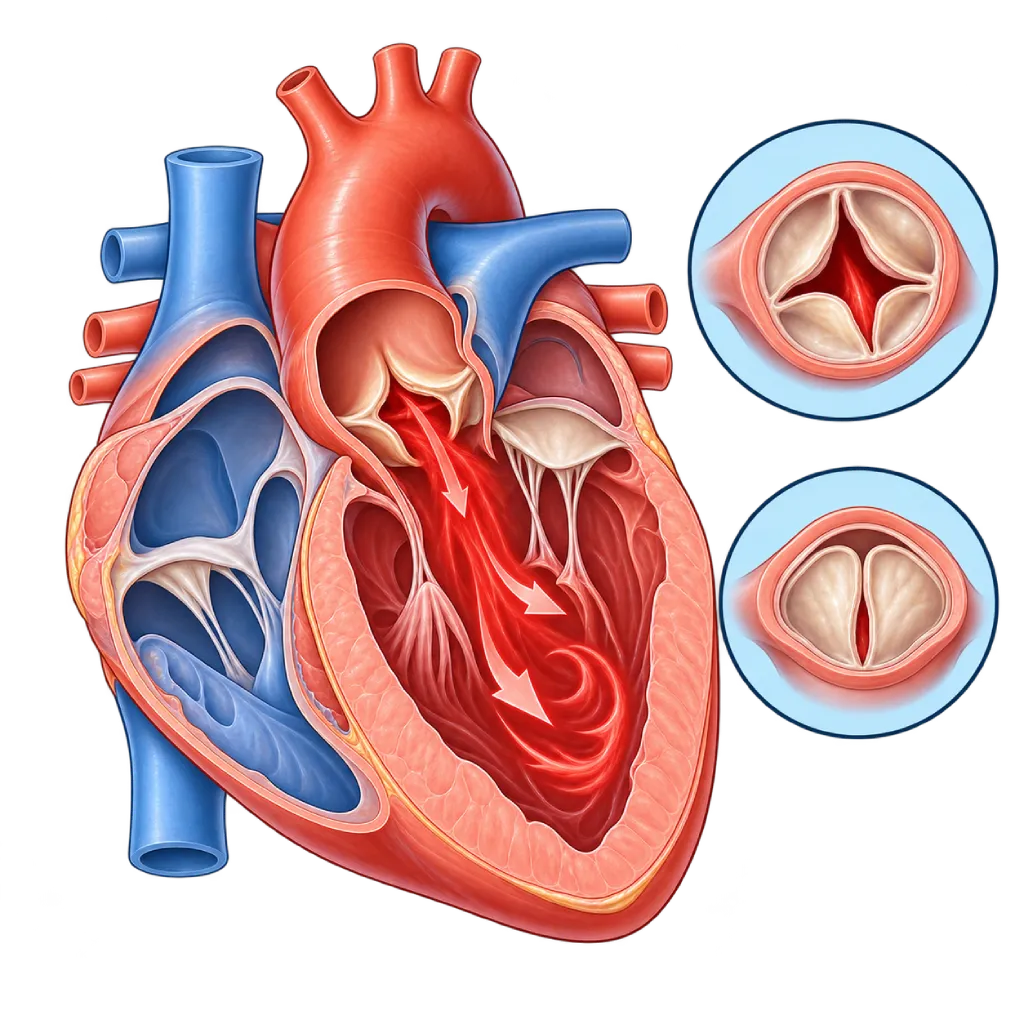
Aortic regurgitation is a leak in the aortic valve, so some of the blood already pumped into the aorta flows back into the left ventricle. Over time, the left ventricle enlarges, often before symptoms appear.
SourcesSigns That Need Urgent Help
- Severe shortness of breath that comes on suddenly
- A cough with pink, frothy sputum
- Severe chest or back pain that feels like tearing
- Pale, cold, sweaty skin with weakness or confusion
- Fainting or nearly fainting
- High fever with shortness of breath in people with a valve abnormality or an artificial valve
If these signs appear, go to the nearest emergency department right away or call Heart Attack Center 1500 258.
01 / Understanding the condition
About Aortic Regurgitation
The aortic valve sits at the exit of the left ventricle, the heart chamber that pumps blood to the whole body through the aorta. After blood leaves, this valve closes tightly so blood does not come back. In aortic regurgitation, also called aortic insufficiency, the valve does not close tightly. Each time the heart rests between beats, some blood flows back from the aorta into the left ventricle. This condition belongs to the group of valve leaks covered on the Valve Regurgitation / Insufficiency page.
Two Sources of the Problem
The leak can come from the valve leaflets themselves, for example a bicuspid aortic valve that has only two leaflets, rheumatic heart disease, calcification, or a valve infection. The leak can also come from a widened aortic root that pulls the leaflets apart so they no longer meet, for example in long-standing high blood pressure, Marfan syndrome, or age-related widening of the aorta. Telling these two sources apart is important because it determines the type of surgery chosen.
Chronic and Acute
In the chronic form, the leak grows slowly. The left ventricle handles the extra blood by enlarging, so many people still feel well for years. However, if the ventricle keeps enlarging, the heart muscle can weaken. That is why the 2021 ESC/EACTS and 2020 ACC/AHA guidelines recommend treatment not only when symptoms appear, but also when echocardiography shows that the left ventricle has enlarged beyond a certain limit or that its pumping strength is starting to decline.
In the acute form, a severe leak happens suddenly, for example from an infection that damages the valve leaflets or a tear in the aortic wall (aortic dissection). The left ventricle has no time to adapt, so severe shortness of breath develops and blood pressure drops. This situation needs emergency treatment and often urgent surgery.
Treatment
A mild to moderate leak usually only needs monitoring, along with blood pressure control if you have high blood pressure. A severe leak that meets the criteria is treated with aortic valve replacement or, for certain valves, valve repair. If the aortic root is also widened, the valve and the aortic root can be treated in a single operation. After the procedure, checkups are still needed to monitor valve function, the size of the left ventricle, and the aorta.
02 / Understanding the condition
Symptoms to Recognize.
Common Symptoms
- Shortness of breath during activity
- Tiring easily and reduced stamina
- A strong or pounding heartbeat, especially when lying on your left side
- A forceful pulse felt in the neck or head
- Shortness of breath when lying flat, or waking at night short of breath
- Chest pain, sometimes at night
- A heart murmur that a doctor hears during a routine checkup
03 / Understanding the condition
What Causes This Condition?
- A bicuspid (two-leaflet) aortic valve present from birth
- Widening of the aortic root due to long-standing high blood pressure or aging
- Marfan syndrome and other connective tissue disorders that cause the aorta to widen
- Rheumatic heart disease that makes the valve leaflets shrink
- Valve infection (infective endocarditis) that damages the valve leaflets or makes holes in them
- A tear in the aortic wall (aortic dissection) that involves the aortic root
- Calcification of the aortic valve in older age, often together with narrowing of the valve
- Certain inflammatory diseases, such as ankylosing spondylitis or inflammation of the large blood vessels
04 / Understanding the condition
Who Is at Higher Risk?
Medical
Uncontrolled high blood pressure, a history of endocarditis or rheumatic fever, autoimmune diseases such as ankylosing spondylitis, and known widening of the aorta.
Genetic
A bicuspid aortic valve, Marfan syndrome, and inherited connective tissue disorders increase the risk. Close family members of people with these conditions may be advised to have echocardiography.
Age
Widening of the aortic root and changes in the valve tissue become more common with age.
Lifestyle
Injecting drugs increases the risk of valve infection. Smoking and untreated high blood pressure also damage the aortic wall.
Groups at Higher Risk
- People with a Bicuspid Aortic Valve: A two-leaflet valve can leak or narrow and often comes with a widened aorta, so regular checkups are needed.
- People with Marfan Syndrome: The aortic root widens easily and pulls on the aortic valve, so the size of the aorta needs routine monitoring.
- People with Long-Standing Hypertension: Years of high blood pressure can widen the aortic root and worsen the leak.
- Rheumatic Fever Survivors: Rheumatic inflammation can damage the aortic valve, often together with the mitral valve.
05 / Understanding the condition
How Is It Diagnosed?
Through a stethoscope, the doctor may hear a characteristic murmur between the two heart sounds and often finds a wide gap between the upper and lower blood pressure numbers. Echocardiography is the main test to see the shape of the valve and the cause of the leak, measure its severity, and assess the size and strength of the left ventricle and the aortic root. The size of the left ventricle is what is monitored over time to decide when to treat.
Cardiac MRI helps measure the volume of the leak and the size of the ventricle when echocardiography results are unclear. A CT scan maps the full size of the aorta, especially if the aortic root is widened. Transesophageal echocardiography is used to see the valve in more detail or to look for infection. An exercise test assesses the ability to be active in people who feel they have no symptoms. Before surgery, the coronary arteries are checked with CT or catheterization.
Physical Examination
Listening for a murmur between the two heart sounds, feeling for a strong pulse, and measuring a wide gap between the upper and lower blood pressure numbers.
Echocardiography
The main test to assess the shape of the valve, the cause and severity of the leak, the size and function of the left ventricle, and the size of the aortic root.
Cardiac MRI
Measures the volume of the leak and the size of the left ventricle in detail when echocardiography results are not clear enough.
Cardiac CT Scan
Maps the full size of the aorta and, in certain patients, checks the coronary arteries before surgery.
Treadmill Stress Test
An exercise test to assess your ability to be active and confirm whether a severe leak causes symptoms.
Electrocardiogram (ECG)
Looks for signs of left ventricular enlargement and heart rhythm problems.
06 / Understanding the condition
Treatment Options.
Treatment is decided by a doctor after an assessment. The categories below can help you follow the conversation with your doctor.
Regular Monitoring
A mild to moderate leak is monitored with regular echocardiography; a severe leak without symptoms is monitored more closely to track the size and function of the left ventricle.
Blood Pressure Control
If you have high blood pressure, ACE inhibitors, ARBs, or calcium channel blockers help reduce the workload on the left ventricle. Your doctor decides which type.
Medicines to Slow Aortic Widening
In Marfan syndrome, beta blockers or ARBs may be used to slow widening of the aortic root, based on your doctor's assessment.
Aortic Valve Replacement
The valve is replaced with a mechanical or biological artificial valve through surgery when a severe leak causes symptoms, or when the left ventricle starts to enlarge or weaken.
Repair of the Valve and Aortic Root
In certain patients, the natural valve can be kept, or the valve and the widened aortic root are treated together in a single operation.
Treatment of a Sudden Leak
A severe leak that appears suddenly is treated in the intensive care unit and usually requires urgent surgery.
07 / Understanding the condition
Complications to Watch For.
Heart Failure
A left ventricle that keeps enlarging eventually weakens, causing shortness of breath, swelling, and tiring easily. Covered on the Heart Failure page.
Reduced Left Ventricular Function
Pumping strength can drop before symptoms are felt. If treatment comes too late, ventricular function does not always recover after surgery.
Heart Rhythm Problems
An enlarged ventricle is more prone to rhythm problems. Covered on the Heart Rhythm Disorders / Arrhythmia page.
Infective Endocarditis
A leaky valve is more easily infected, and infection can make the leak worse. Covered on the Infective Endocarditis page.
Complications of Aortic Widening
If the leak is caused by a widened aortic root, the aorta can keep widening and is at risk of tearing. Covered on the Thoracic Aortic Aneurysm page.
08 / Understanding the condition
What Can You Do?
- Control your blood pressure to the target your doctor sets
- Keep your teeth and mouth clean and have regular dental checkups
- Make sure a child's throat infection is fully treated to prevent rheumatic fever
- If you have a bicuspid aortic valve or Marfan syndrome, follow your schedule for echocardiography and aortic monitoring
- Avoid injecting drugs, which can carry germs to the heart valves
- Talk to your doctor before heavy weight training if you have a moderate to severe leak or a widened aorta
09 / Understanding the condition
When Should You See a Doctor?
See a cardiologist if a heart murmur, a wide gap between your blood pressure numbers, or a bicuspid aortic valve is found. If you already know you have aortic regurgitation, checkups remain important even if you feel well, because the left ventricle can enlarge without symptoms. Go to the emergency room right away if severe shortness of breath comes on suddenly or you feel severe chest and back pain.
- Shortness of breath or tiring quickly during activities that used to feel light
- A pounding heartbeat, especially when lying down
- Waking at night short of breath
- Fever for no clear reason in people with a leaky valve or an artificial valve
- A close relative with a bicuspid aortic valve, Marfan syndrome, or a widened aorta
Don't Wait in an Emergency.
If symptoms are severe or come on suddenly, go to the nearest emergency department right away or call Heart Attack Center 1500 258, rather than waiting for an appointment.
10 / Common questions
Questions You May Have.
Frequently asked questions about aortic regurgitation.
Does mild aortic regurgitation need treatment?
A mild leak usually does not need a procedure and only needs monitoring with regular checkups and echocardiography. If you have high blood pressure, controlling it helps reduce the workload on the heart. What still matters is finding the cause, such as a bicuspid aortic valve or a widened aortic root, because the cause determines how closely you need to be monitored.
Why is surgery recommended when I do not have any symptoms?
In severe aortic regurgitation, the left ventricle can enlarge and weaken before symptoms appear. If treatment waits too long, ventricular function does not always recover after surgery. That is why guidelines recommend treatment when the size of the left ventricle goes beyond a certain limit or its pumping strength starts to decline, even without symptoms. Your doctor will explain your measurement results.
Can a leaky aortic valve be replaced through a catheter?
Catheter-based valve implantation was developed mainly for narrowed aortic valves. In a leaky aortic valve without calcification, an artificial valve is harder to anchor securely, so surgery remains the main option. In a small number of patients who cannot have surgery, a catheter procedure may be considered at an experienced center. The heart team assesses whether it is suitable.
How is aortic regurgitation related to widening of the aorta?
The aortic root, where the valve is attached, can widen because of age, high blood pressure, a bicuspid aortic valve, or Marfan syndrome. This widening pulls the valve leaflets apart so they do not meet and the valve leaks. That is why testing for aortic regurgitation always includes measuring the aorta. If both need treatment, the valve and the aortic root can be repaired in a single operation.
Can I exercise with aortic regurgitation?
With a mild to moderate leak and a left ventricle of normal size and function, you can usually do the majority of physical activities. With a severe leak, an enlarged ventricle, or a widened aorta, strenuous exercise and heavy lifting need to be limited. Ask your doctor to assess which types of exercise are safe, sometimes with the help of an exercise test.
Do my family members need to be checked?
If the cause is a bicuspid aortic valve, Marfan syndrome, or inherited widening of the aorta, close relatives such as parents, siblings, and children may be advised to have echocardiography. These conditions often cause no symptoms, so testing helps find them earlier. If the cause is an infection or rheumatic disease, family testing is usually not needed.
Sources and Medical Review
Translated from the Indonesian edition medically reviewed by Dr. dr. Dafsah A. Juzar, Sp.JP(K).
Sources as cited in the Indonesian edition.
- Vahanian A, Beyersdorf F, Praz F, Milojevic M, Baldus S, Bauersachs J, et al. 2021 ESC/EACTS Guidelines for the management of valvular heart disease. Eur Heart J. 2022;43(7):561-632.
- Otto CM, Nishimura RA, Bonow RO, Carabello BA, Erwin JP 3rd, Gentile F, et al. 2020 ACC/AHA Guideline for the Management of Patients With Valvular Heart Disease: A Report of the American College of Cardiology/American Heart Association Joint Committee on Clinical Practice Guidelines. Circulation. 2021;143(5):e72-e227.
- Zoghbi WA, Adams D, Bonow RO, Enriquez-Sarano M, Foster E, Grayburn PA, et al. Recommendations for Noninvasive Evaluation of Native Valvular Regurgitation: A Report from the American Society of Echocardiography Developed in Collaboration with the Society for Cardiovascular Magnetic Resonance. J Am Soc Echocardiogr. 2017;30(4):303-371.
- Isselbacher EM, Preventza O, Hamilton Black J 3rd, Augoustides JG, Beck AW, Bolen MA, et al. 2022 ACC/AHA Guideline for the Diagnosis and Management of Aortic Disease: A Report of the American Heart Association/American College of Cardiology Joint Committee on Clinical Practice Guidelines. Circulation. 2022;146(24):e334-e482.
- Akinseye OA, Pathak A, Ibebuogu UN. Aortic Valve Regurgitation: A Comprehensive Review. Curr Probl Cardiol. 2018;43(8):315-334.
- Delgado V, Ajmone Marsan N, de Waha S, Bonaros N, Brida M, Burri H, et al. 2023 ESC Guidelines for the management of endocarditis. Eur Heart J. 2023;44(39):3948-4042.
Doctors Who Treat This Condition

Dr. dr. Dudy A. Hanafy, Sp.BTKV, Subsp. JD(K), MARS
Adult Cardiac Surgery
Advanced Cardiovascular Surgical Care +1 center
Clinical focusMinimally Invasive Cardiac Surgery · Coronary Artery Bypass Surgery
View Profile
Dr. dr. Dafsah A. Juzar, Sp.JP(K)
Interventional Cardiology
Coronary Intervention Procedures +1 center
Clinical focusComplex Coronary Intervention · Cardiac Catheterization
View Profile
dr. Suko Adiarto, Sp.JP(K), Ph.D.
Interventional Cardiology
Vascular Diagnostic and Therapeutic Center +1 center
Clinical focusCoronary Intervention · Peripheral Vascular Intervention
View Profile