
Quick answer
What Is Congenital Heart Surgery?
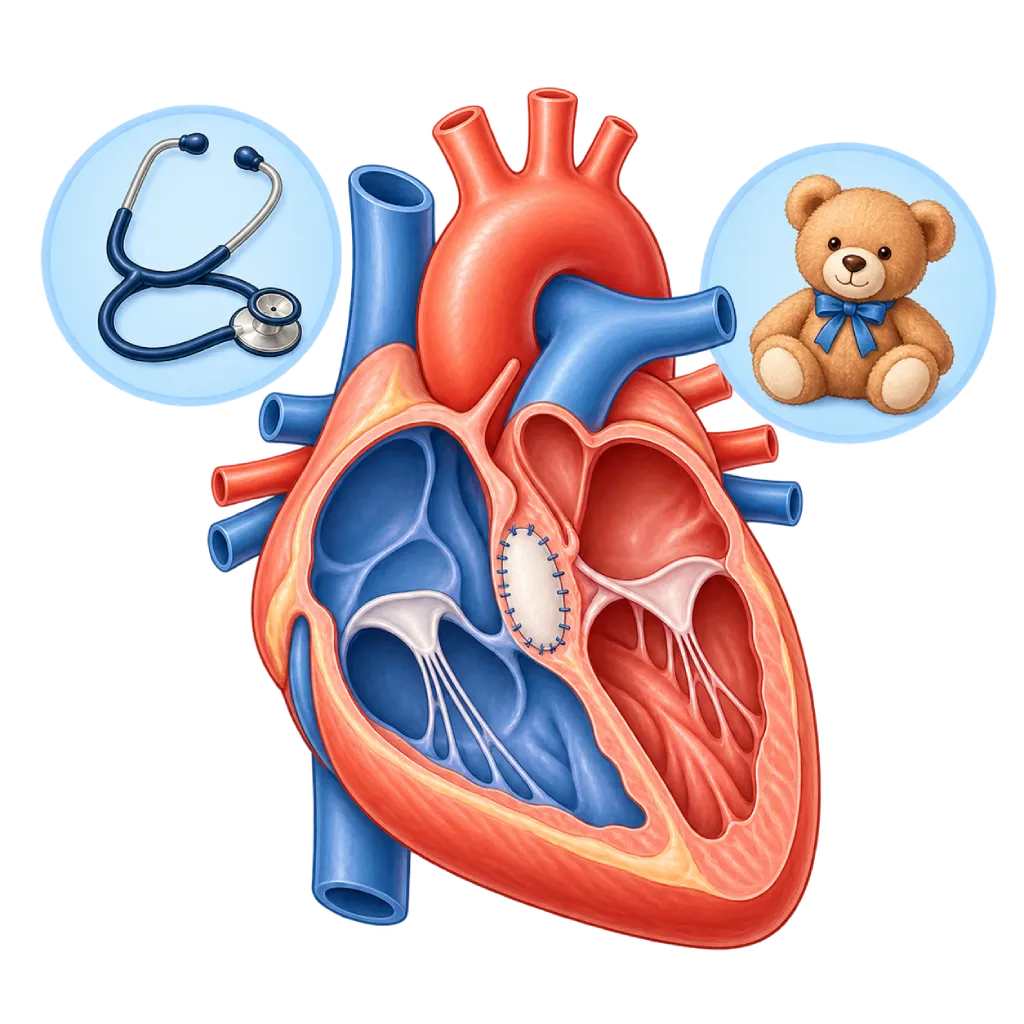
Congenital heart surgery is an operation to repair structural heart problems present from birth, such as a hole in the heart's dividing wall, a narrowed valve, or switched major blood vessels. It is performed in babies, children, and adults, usually under general anesthesia with a heart-lung machine, and takes about 3 to 6 hours.
Sources01 / Understanding the procedure
About Congenital Heart Surgery
What Is Congenital Heart Surgery
Congenital heart disease is an abnormality in the shape of the heart or the major blood vessels that develops while the baby is growing in the womb. It is found in about 8 to 9 of every 1,000 live births. Some cases are mild and only need monitoring, some can be treated through a catheter, and others need surgery. Congenital heart surgery is an operation to repair these abnormalities so that blood flows along its proper path.
Defects That Often Need Surgery
- Holes in the heart's dividing wall: VSD, certain types of ASD, and atrioventricular septal defect, which are closed with stitches or a patch.
- Tetralogy of Fallot: a hole in the wall between the lower chambers together with a narrowed outflow path for blood to the lungs, which makes the baby look blue.
- Transposition of the great arteries: the positions of the aorta and pulmonary artery are switched; it is usually operated on in the first weeks of life.
- Coarctation of the aorta: a narrowing of the aorta that can be repaired with surgery or through a catheter.
- A heart with only one working pumping chamber: repaired through several stages of surgery from infancy into childhood.
Corrective and Staged Surgery
Corrective surgery repairs the defect directly in a single operation, for example closing a VSD. For complex defects, surgery is done in stages: the first operation helps the baby survive and grow, then the next operation is done when the body is more ready. The majority of operations use a heart-lung machine, which takes over the work of the heart and lungs while the heart is being repaired.
Surgery or Catheter
Some defects can be treated through a catheter without opening the chest, such as certain septal holes and PDA, covered on the Heart Defect Closure page, or narrowing of the aorta, covered on the Balloon Angioplasty for Aortic Coarctation page. In some children, surgery and catheter procedures are combined in one plan. The pediatric cardiologist and the surgeon decide together on the suitable approach.
Congenital Heart Surgery in Adults
Thanks to surgery in childhood, many people with congenital heart disease now grow into adulthood. Some need repeat surgery, for example to replace the pulmonary valve after tetralogy of Fallot repair. In some patients, pulmonary valve replacement can be done through a catheter, covered on the Transcatheter Pulmonary Valve Replacement page. Others only discover their defect as adults. Lifelong follow-up with a cardiologist who treats adult congenital heart disease is recommended.
02 / Understanding the procedure
When Is This Procedure Considered?
A doctor may consider this procedure in the situations below. The decision is always made after a thorough assessment.
- Large Hole in the Heart's Dividing WallA VSD or atrioventricular septal defect that strains the heart and lungs.
- Baby Looks BlueLow oxygen levels due to defects such as tetralogy of Fallot or transposition of the great arteries.
- Narrowed Valve or Blood VesselA narrowed pulmonary valve, aortic valve, or aorta that is not suitable for catheter treatment.
- Defects Not Suitable for a CatheterFor example, a sinus venosus ASD or a large hole with too little rim.
- Repeat Surgery in AdultsFor example, replacing the pulmonary valve or an artificial conduit after surgery in childhood.
Situations to Consider First
- Lung Pressure Already Very HighClosing a hole is no longer beneficial once blood has reversed to flow from right to left.
- Serious Infection Not Yet ResolvedPlanned surgery is postponed until the infection, including a lung infection, improves.
- Mild DefectsA small hole or mild narrowing only needs monitoring without surgery.
- Unstable General ConditionThe baby needs to be stabilized first, for example with medicines or breathing support, when the condition allows.
03 / Before the procedure
How Should You Prepare?
Preparing for congenital heart surgery involves the whole family. The team will explain the surgical plan, the expected length of stay, and the risks before you sign the consent form.
Tests before surgery. Echocardiography, ECG, chest X-ray, and blood tests. If needed, a cardiac CT scan, cardiac MRI, or cardiac catheterization to map the defect.
Nutrition. Babies with heart failure often need high-calorie milk or a feeding tube so they reach an adequate weight before surgery.
General health. Tell the team if your child has a fever, cough, cold, or diarrhea. Have older children's teeth checked and treated before planned surgery.
Fasting and medicines. Follow the fasting schedule and medicine instructions from the team. Do not stop heart medicines without guidance.
Preparing your child and family. Explain things to your child in simple words. Arrange for someone to stay with your child during the hospital stay, including while your child is in the intensive care unit.
Unsure about the preparation instructions? Ask our team before the procedure.
04 / During the procedure
How Is the Procedure Done?
Surgery is done in the operating room under general anesthesia and takes about 3 to 6 hours, depending on the type of defect. Complex operations can take longer.
Anesthesia and Monitoring
Your child is given anesthesia and fitted with a breathing tube and an IV line. An echocardiogram through the esophagus is used to monitor the heart during surgery.
Opening the Chest and Connecting the Heart-Lung Machine
The surgeon usually opens the breastbone down the middle. For certain defects, a smaller cut on the side of the chest may be used. The heart is connected to a heart-lung machine and then temporarily stopped.
Repairing the Defect
Holes are closed with a patch, narrowed valves or outflow paths are widened, or major blood vessels are moved to their proper place.
Checking the Result and Closing the Chest
Once the heart starts beating again, the repair is checked with echocardiography. Chest tubes and temporary pacing wires are placed before the chest is closed.
05 / Benefits and risks
Benefits and Risks Should Be Discussed Together.
Every medical procedure has benefits and risks. Your doctor will explain both for your situation before the procedure.
Benefits You Can Expect
- Blood Flows Along Its Proper Path AgainThe heart and lungs no longer have to work too hard once the defect is repaired.
- Better Oxygen LevelsIn blue (cyanotic) heart defects, the color of the lips and skin usually improves after the repair.
- Better Growth and DevelopmentBabies feed more easily, gain weight, and become more active after recovery.
- Longer Life ExpectancyThe majority of children who have surgery now grow into adulthood.
The benefits of a procedure are not a promise of a cure. Ask how the results will affect your care plan.
Risks You Should Know
- BleedingMay require a transfusion or, occasionally, a repeat operation to stop it.
- Heart Rhythm DisordersOften temporary; a small proportion of patients need a pacemaker.
- InfectionIn the surgical wound, lungs, or bloodstream; prevented with antibiotics and wound care.
- Residual Defects or Repeat SurgerySome defects need further procedures as the child grows.
- Nervous System and Developmental ProblemsSeizures or stroke are rare; the child's development is monitored after surgery.
- Fluid Around the Heart or LungsCan appear a few days to weeks after surgery and sometimes needs to be drained.
Risks can differ from person to person. A full explanation and consent are given after an individual assessment.
06 / After the procedure
What Is Recovery Like?
After surgery, your child is cared for in the pediatric intensive care unit, then on the ward. The hospital stay is usually about 1 to 2 weeks and can be longer after complex surgery or for newborns.
Intensive care unit. Your child may still need a breathing machine, chest tubes, and temporary pacing wires. These are removed gradually. Parents can stay with their child according to the unit's rules.
Pain and wound care. Pain is managed with medicines. Keep the wound clean and dry. Avoid lifting your child by the armpits and avoid rough play for about 6 weeks so that the breastbone can heal.
Eating, growth, and development. Appetite usually returns gradually. Your child's growth and development are monitored at follow-up visits.
Long-term follow-up. Follow-up with a cardiologist continues into adulthood, including the transition to a cardiologist for adult congenital heart disease. Some patients need preventive antibiotics before dental procedures.
Warning signs. Go to the emergency room right away if your child has:
- Fast breathing, shortness of breath, or lips becoming bluer
- Fever, or a wound that is red, swollen, and oozing pus
- Persistent vomiting, refusing to drink, or severe weakness
- Seizures, fainting, or weakness on one side of the body
- Swelling of the face, belly, or legs
Know the Signs That Need Prompt Care.
Follow the team's guidance on warning signs. If severe or sudden symptoms appear after the procedure, go to the nearest emergency department right away or call Heart Attack Center 1500 258.
07 / Team and support
Doctors and Procedure Support
The doctors below are listed for this procedure. Listed by name, not by ranking.

Dr. dr. Dudy A. Hanafy, Sp.BTKV, Subsp. JD(K), MARS
Adult Cardiac Surgery
Advanced Cardiovascular Surgical Care +1 center
Clinical focusMinimally Invasive Cardiac Surgery · Coronary Artery Bypass Surgery
View Profile
dr. Salomo Purba, Sp.BTKV, Subsp.JPK(K)
Pediatric and Congenital Heart Surgery
Congenital and Structural Heart Center +2 centers
Clinical focusPediatric Heart Surgery · Congenital Heart Defect Surgery
View Profile
dr. Tartila, Sp.A, Subsp.ETIA(K)
Pediatric Emergency and Intensive Care
Congenital and Structural Heart Center
Clinical focusPediatric Intensive Care · Pediatric Emergency Care
View ProfileOperating Theatre (Cardiac Operating Room)
An operating room dedicated to heart and blood vessel surgery, where the surgical, anesthesia, perfusion, and nursing teams work…
Minimally Invasive Cardiac Surgery (MICS) Technology
A way of performing heart surgery through a small incision between the ribs or through part of the breastbone, using long-shafted…
The availability of technology and test support is confirmed with the team. Technology is chosen according to clinical need.
08 / Common questions
Before You Plan the Procedure.
Questions parents and patients often ask about congenital heart surgery.
At what age does a child need surgery?
It depends on the type of defect. Some defects, such as transposition of the great arteries, are operated on in the first weeks of life. Large VSDs and tetralogy of Fallot are usually operated on within the first year. Milder defects can wait until childhood. The pediatric cardiologist will decide the timing based on symptoms, growth, and test results.
How long will my child stay in the hospital after surgery?
For simpler operations, such as closing an ASD or VSD, children usually stay in the intensive care unit for 1 to 3 days and go home in about one week. Complex surgery or surgery in newborns may require a hospital stay of several weeks. The team will explain what to expect for your child before surgery.
Can my child grow and be active normally after surgery?
Many children who have surgery can grow, go to school, and play like their peers. The outcome depends on the type of defect and its repair. Some children need developmental monitoring or learning support. Exercise advice is tailored to each child's heart condition and discussed with the cardiologist at regular follow-up visits.
Can congenital heart surgery be done in adults?
Yes. Some people only discover their defect as adults, for example a sinus venosus ASD. Others had surgery as children and now need repeat surgery, such as replacement of the pulmonary valve or an artificial conduit. Surgery in adults is planned by taking into account previous operations and the current condition of the heart.
Will my child need more surgery later in life?
Some children do not need further surgery, especially after a simple hole closure. Complex defects are often repaired in stages, and valves or artificial conduits may need to be replaced as the child grows. Some repeat procedures can be done through a catheter. For this reason, regular follow-up visits are still needed even if your child looks healthy.
What can parents do to help with recovery?
Stay with your child, follow the medicine schedule, and keep the wound clean. Give nutritious food as advised and encourage your child to move gradually. Keep your child's teeth clean and complete immunizations as directed by the doctor. Write down questions to bring to follow-up visits, and contact the team right away if any warning signs appear.
Sources and Medical Review
Translated from the Indonesian edition medically reviewed by dr. Salomo Purba, Sp.BTKV, Subsp.JPK(K).
Sources as cited in the Indonesian edition.
- Baumgartner H, De Backer J, Babu-Narayan SV, et al. 2020 ESC Guidelines for the management of adult congenital heart disease. Eur Heart J. 2021;42(6):563-645.
- Stout KK, Daniels CJ, Aboulhosn JA, et al. 2018 AHA/ACC Guideline for the Management of Adults With Congenital Heart Disease: A Report of the American College of Cardiology/American Heart Association Task Force on Clinical Practice Guidelines. Circulation. 2019;139(14):e698-e800.
- Marino BS, Lipkin PH, Newburger JW, et al. Neurodevelopmental Outcomes in Children With Congenital Heart Disease: Evaluation and Management: A Scientific Statement From the American Heart Association. Circulation. 2012;126(9):1143-1172.
- Liu Y, Chen S, Zühlke L, et al. Global birth prevalence of congenital heart defects 1970-2017: updated systematic review and meta-analysis of 260 studies. Int J Epidemiol. 2019;48(2):455-463.
- Mandalenakis Z, Rosengren A, Skoglund K, et al. Survivorship in Children and Young Adults With Congenital Heart Disease in Sweden. JAMA Intern Med. 2017;177(2):224-230.